The Ease of Mourning Charlie Kirk
originally posted: 17 September 2025
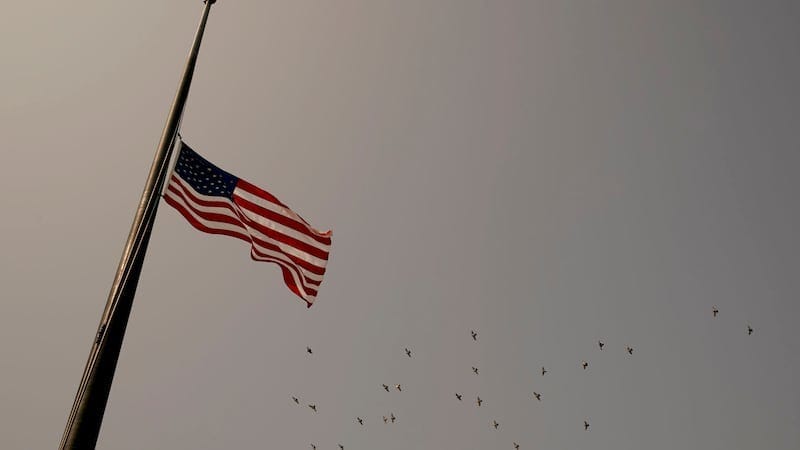
Today in New York City, I walked past flags flying half-mast to represent a nation in grief. Grief is what I have been reflecting most on over the last few days, more specifically, who we are allowed to grieve and how we are allowed to grieve them.
There has been significant back and forth in the discourse over the reaction to Conservative firebrand Charlie Kirk’s public assassination. Let me begin by stating that the murder was deeply disturbing, as was its fervent circulation on social media. It was an unnecessary act of violence that deserves and requires condemnation. Many have expressed their grief, some have pointedly refused to, others have called for war, and many have made jokes. Every single reaction has been condemned and defended.
Some liberals have jumped to whitewash Kirk’s image to prove once again they are the most reasonable, benevolent people in the room, while the left have taken the opportunity to turn his death into a stand-up show. While those two groups bicker about who has the most correct response, Conservatives and the government have made a martyr out of Kirk and transformed the spectacle of his death into a turning point in their cultural war.
The question at the centre of it all is: what do we do with a death like this?
The Silly Serious is a reader-supported publication. To receive new posts and support my work, consider becoming a free or paid subscriber.
The killing of Kirk is a very 21st century death. The televised assassination of JFK sent shockwaves around the world, but what happened the other day can only be described as a snuff film becoming wholly unavoidable to anyone with a cell phone. We were not meant to live like this. And the visceral reaction everyone had to watching a murder happen right before their eyes is to be expected. This spectacle is exaggerated because the victim was a pundit, a class that up until this point, had been seemingly protected by a social norm: we only kill politicians. But it cannot just be the visual and visceral nature of the killing. After almost two years of some of the most graphic images imaginable coming from Gaza, and with countless members of previously protected classes (journalists, medics, aid workers) being killed, the reaction cannot be simplified to the visceral and unprecedented nature of the video.
A death like this makes the inequality of grief immediately apparent. The politics of grief is considered a lot in critical theory, by thinkers like Judith Butler, Frantz Fanon, and Giorgio Agamben. According to Butler, some people in this world are deemed grievable, while others are not. This distinction correlates with the value society gives to certain lives (not how many people personally grieve the loss of an individual). Lives that are considered ungrievable (treated as if they can be neither lost nor mourned) exist in what Fanon called “the zone of non-being”. Obvious examples of people who exist in this zone are asylum seekers and the homeless.
To be grievable is to be understood socially in a way that makes it evident to you that your life matters; the loss of your life would matter; your body will be treated as one that is able to live and thrive. When you die, it matters. Not in the interpersonal sense but in the political sense. The world acts in a way to try and prevent your death, and when your death unexpectedly occurs it is seen as a failure.
But there are many people in the world who are not seen as politically grievable. Around the world, countless innocent people die, and their death is not mourned. No one’s day stops when they hear the news. No video, no matter how graphic, causes a global gasp. When the death of George Floyd caused people to rush into the streets and demand the world grieve his death because black lives matter, Kirk said that the movement was destroying the fabric of America. People all around America are proclaiming that Charlie was killed for his words, as if this is somehow more condemnable than being killed for the colour of your skin, your sexuality, or the nation in which you reside.
Assertions that those lives matter (such as the Black Lives Matter protests, or the protests against the Gazan genocide, or public vigils for victims of domestic violence) are attempts to break through the political schema.
What interested me following the assassination of Kirk was the extent to which actively and intentionally not grieving was an attempt to break the political schema, especially in a context where people have already lost their jobs for not grieving appropriately and the administration is trying to make any celebration of Kirk’s death a punishable offense. When a highly ideological government pushes for a firebrand to be ‘lain in honor’, is it political action not to grieve and to do so in a visible way? I understood some of the callous responses to Kirk’s death as an act of non-violent emotional disobedience. Was it offensive? Yes. Socially bad taste? Sure. But it was not violent. It was done, in some cases, to serve a purpose. To call into question the inequality of grievability.
There questions that linger around Charlie Kirk’s speech. Was he a champion of free speech and good faith debate? Did he do politics ‘the right way’? And can we so clearly separate Kirk’s speech from violence?
By my measure the first questions are easily answered. Charlie Kirk was an enemy of free speech and what he did was not good faith debate. His campus tour was an exercise in political theatre, expressly designed to manufacture outrage and attract attention to propaganda. For this exercise in clip farming to be interpreted as good faith discourse is a complete indictment on the current state of the politics. Kirk’s entire professional pursuit was grounded in bad faith engagement, where he said provocative, divisive bigotry without the ability to be held accountable or fact checked. Why do you think he focused on college campuses? Of course, to appeal to the youth, but also to ensure that his debate opponents were never experts in the field. It is surprising to see even Jacobin applauding Kirk for not descending “into personal attacks” as if cruelty has never been exercised under the guise of civility.
Charlie Kirk was in the business of spectacle, not the business of debate. It was never a contest of ideas and always a contest of charisma. And while some may want to sanitise his product to allow them to live in the delusion that any kind of marketplace of ideas still exists, we should not allow his propaganda to be corroborated because he died an untimely and horrific death. Keep in mind that those inciting violence in the name of his memory are practicing the exact kind of politics he did.
I do not refute that the death of Charlie Kirk should be seen as an attack on free speech, but not because I agree that Charlie was a champion of the first amendment. Within hours of Kirk’s death, networks were firing employees for their response to the shooting. In the case of Matthew Dowd, he was fired for saying that Kirk spoke “hateful words” a statement far more factual than any of the administrations earlier castigations against the left for causing the killing by being lunatics and terrorists. Analysts who suggested the killer was a member of antifa, or transgender, unsurprisingly did not lose their jobs. Comedy Central was quick to pull the episode of South Park that satirised Kirk from the air, likely fearing repercussions. And commentators across the entire political spectrum reacted with an emotional intensity that could only be interpreted as a visceral fear that they might be next. Such a killing has an undeniable chilling effect on speech, whether Kirk’s speech was the motive for his murder or not.
The administration was quick to announce that immigrants found to have celebrated Kirk’s death would be deported, and a movement quickly formed to create lists of anyone who did anything on social media other than condemn the killing and mourn Kirk. These actions are unquestionably a more egregious attack on free speech than the death of Kirk itself. A political assassination is, of course, abhorrent but not unfamiliar in the context of American history. This is only the beginning of the administration’s plan to crack down on speech which is likely to be unveiled this week according to Susie Wiles, White House Chief of Staff.
Let’s also be clear about what kind of speech has not chilled. Following Kirk’s death, Congressman Clay Higgins wrote that he will use, “Congressional authority and every influence with big tech platforms to mandate immediate ban for life of every post or commenter that belittled the assassination of Charlie Kirk. I’m also going after their business licenses and permitting, their businesses will be blacklisted aggressively, they should be kicked from every school, and their drivers licenses should be revoked. I’m basically going to cancel with extreme prejudice these evil, sick animals who celebrated Charlie Kirk’s assassination." Famous right wing actor James Woods penned a threatening letter on social media: “Dear leftists: we can have a conversation or a civil war. One more shot from your side and you will not get this choice again.” Steve Bannon said on his show the War Room: “Charlie Kirk is a casualty of war. We are at war in this country. We are.”
This is not to highlight the double standard but to highlight the relationship between language and violence. The language in the responses above are obviously calling for violence. Which leads me to my second question. How clear is the delineation between Kirk’s words and violence? I want to be very clear; I do not believe that words are violence. However, I do believe that words play in integral part in making violence permissible. We are social creatures, connected to the world and each other through language. Words are the vehicles for our understanding, and they are key to constituting our sense of self in the world.
Here’s the thing. When it comes to violence, we view it as largely impermissible, with one obvious exception: self-defence. The existence of a self-defence exception begs the question, how do we constitute our ‘selves’? Is it just our physical body, our family, our community, those who share our skin colour, our heritage, or our ideology? The existence of self-defence necessarily creates a boundary.
And the truth is, words create a reality in which violence is allowed to occur to some people. Rhetoric is used to present some people as more dangerous, more threatening, more unpredictable, less valuable, less rational, less human. When a black person is shot for reaching into their pocket to get their identification, the police officer is not shooting a person, they are shooting the racist phantasm created by speech. The kind of speech used by Charlie Kirk, that transforms people from human beings into perpetual existential threats. By turning people into threats, murder is turned into self-defence.
It is interesting that at the same time the rhetoric of the left is being blamed for the death of Charlie Kirk, no pause is given to the deaths that may have been made possible by the world Charlie Kirk created through his rhetoric. The ideas of Kirk have found their ways into the manifestos of shooters, just like the one who took his life, as justification for their actions. Drenched in the language of self-defence and existential war.
While not the focus of this article, in the interests of putting everything in one place. Kirk said that blacks were less murderous and less dangerous when they had less rights. That it is commonplace in urban America for prowling blacks to target white people for fun. That black women are stealing white people’s jobs, as are those coming across the Sothern Border, who are all part of an antiwhite replacement agenda. He said that no native born American should leave home without a gun. That trans people are mentally ill abominations that should be taken care of by men the way they used to in the 50s and 60s (read: lynched). That women lie about being raped, and statistics are not accurate as a result, and that women having access to reproductive care is worse than the Holocaust.
Conservatives cannot argue that the rhetoric of the left caused the death of Charlie Kirk and simultaneously suggest that the rhetoric of Charlie Kirk was peaceful and nonviolent. But of course,the state’s monopoly on violence, means they also get to decide what counts as violence. And the state can decide that the destruction of property is violent, that college encampments are violence, and that tweets are violence. And then they can use violence to stop it, because the violence of the state is always an act of self-defence.
As the state aligns itself with Kirk, and acts violently in self-defence, will we be able to grieve the lives lost in response?